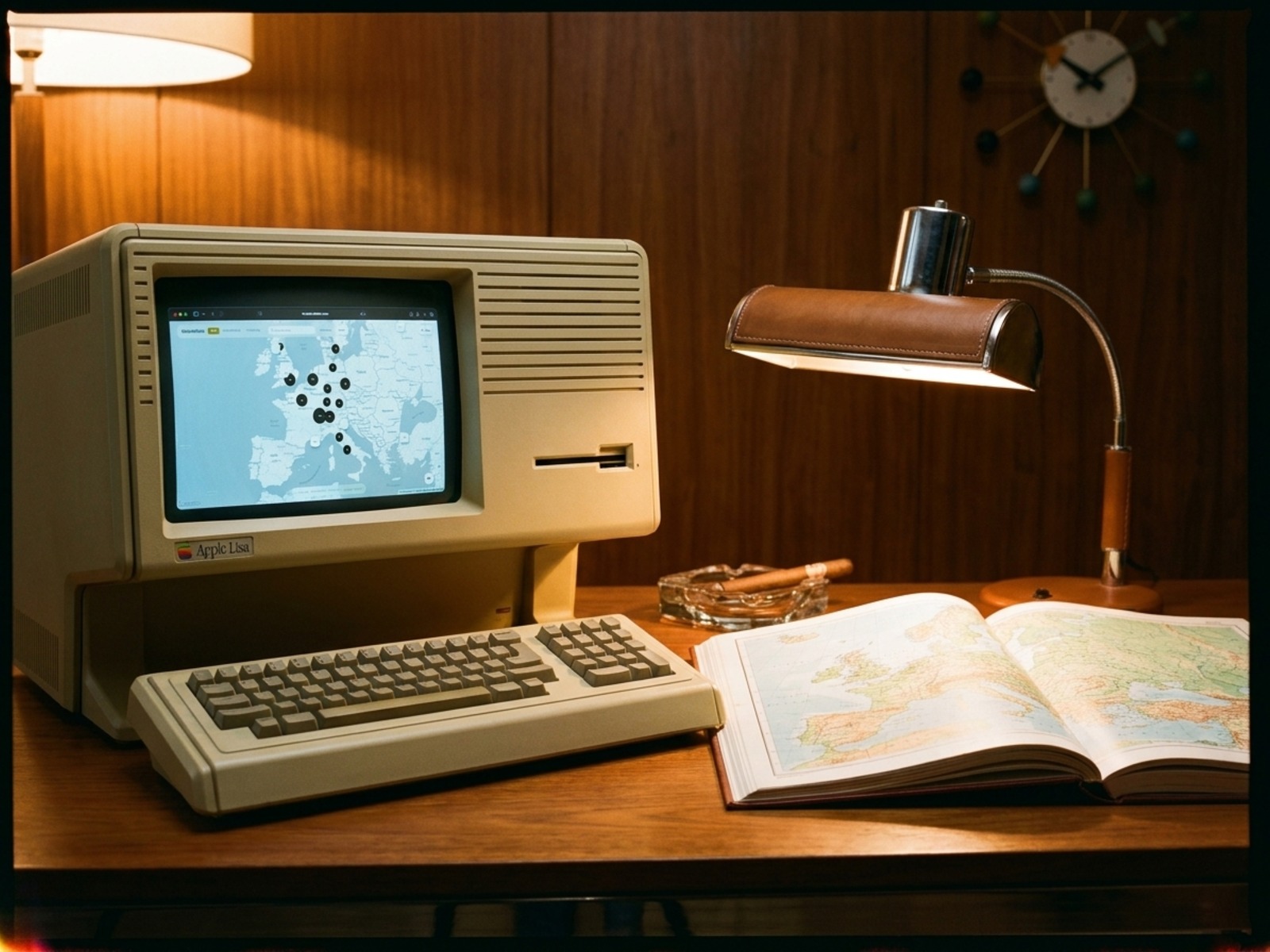
I built Watch Atlas because I wanted to know where every watchmaker in the world was actually based. Not the holding group's PR address. The workshop. The atelier. The valley.
That sentence sounds simple. The map is not.
Watch Atlas is now live. One hundred and sixty-eight brands. Headquarters, manufactures, boutiques. Filters by country, group, and price segment. A graveyard layer for the houses that did not make it. I launched it at Watches & Wonders in Geneva this April and backdated the version stamp to W&W 2026, because the project felt like it had been waiting for that show all along.
Three tools made it buildable in the spare hours I had.
Paperclip for research. My multi-agent personal-ops setup at home runs four agents in a small "company". One of them, a researcher, spent weeks reading Wikipedia infoboxes, Hodinkee deep-dives, brand websites, and a stack of watchmaking books on my desk. I'd ask it to enrich a brand row with founding year, founders, key collections, and the actual manufacture address. It would come back with a structured draft I could vet in a few minutes instead of an afternoon.
Apify MCP for scraping. Where Paperclip's research hit a wall, price tier history, current boutique counts, geocoding for the map, the Apify MCP server filled in. I did not write a scraper from scratch once. I asked Claude to call the right Apify actor, parse the output, and drop it into the schema I was building.
Claude Code for the interface and the data QC. The map is React 18, Vite, Mapbox GL, on a Firestore backend. None of which I wrote line by line. I described what I wanted, watched Claude build it, then iterated on the parts that did not feel right. Same for the data. Every brand row went through a Claude pass to flag inconsistencies before I trusted it on the live map.
Here is the part that humbled me.
The logos.
I had assumed the logos would be the easy bit. Find the SVG. Optimise it. Drop it in. Watchmaking does not work like that. Every brand has a different logo treatment: solid black on white, white on a transparent black, gold on a baroque background, scanned from a 1990s catalogue. Half the SVGs I found online were rasterised exports masquerading as vectors. The rest needed manual recolouring to fit the editorial style of the map.
I tried the agentic route. I really did. I asked Claude, Paperclip, and Apify to find me one hundred and sixty-eight clean logos, normalised to a single visual weight on a transparent background. They got me about thirty. The rest I pulled by hand: opening brand websites, downloading the cleanest asset I could find, running it through SVGO or Photopea, eyeballing the result against the others on the map.
That step took longer than building the entire React app.
It was also the right way. I am happier looking at the map knowing every logo passed my eye, not a pipeline's tolerance.
The launch was timed for Watches & Wonders Geneva for two reasons. One: every watch journalist in the world is in town that week and search volume for individual brand names spikes for seven days. Two: I wanted the map to feel like a valid reference the moment it went live, not a beta still shipping fixes. So I locked the version, backdated it to W&W 2026, and set up shop.
What is next is the obvious stuff. Manufactures and boutiques as separate layers on top of HQs. A travel mode that plans a route through the Vallée de Joux. Filters by complication. A lot of it is data work. Good data work is mostly patience.
If you are building alongside AI agents, the Watch Atlas lesson for me is the boring one. Use the agents for research, scraping, and the interface. Trust your own eyes for the asset work where taste matters most. (It's the same loop I've kept running since I rebuilt this site without being a developer, and the same reason I keep iterating on the skills my agents actually trigger. Build with the agents. Finish with your hands.)
The map is at watch-atlas.com. If you spot a brand I have wrong, or a manufacture I have missed, the contact form is in the footer.
What is the dataset you would build by hand if you had a free week?